Monday, 2 June 2014

1983: The Piano Teacher


Book Name: The Piano Teacher

Author: Elfriede Jelinek

Genre: Novel

Year Published: 1983

So it turns out A Song of Ice and Fire is a terrible series to be reading alongside other books as I never seem to read anything else... but back in March(!) I did finish reading The Piano Teacher. (Thanks E-T for lending me a copy.) The cover described it as "the masterpiece of Elfriede Jelinek, Austria's most famous writer." I'm not sure how true this statement is as I know pretty much nothing about Austrian literature, but I had heard of the film adaptation and I certainly really liked the book. It is about the life of Erika Kohut, who lives with her super overprotective and overbearing mother, her fascination with sex and peep shows and her relationship with one of her students. Whilst the story is a bit hard to describe without just explaining everything that happened, it does cover various points of Erika's life with flashbacks and also follows her mother and student's actions in parts, which makes for quite a choppy and sometimes hard to follow storyline.

When I began reading The Piano Teacher I was worried it wouldn't flow for me. The opening sentences are extremely short and to the point e.g. "She is trying to escape her mother. Erika is in her late thirties."..."Erika entered, her father exited." Whilst these kinds of short sentences were commonplace throughout the book, I ended up finding them a nice change from other authors - Jelinek was able to fit a lot of depth and description into her work without having long winded and lengthy paragraphs about one small detail. On top of that, I also really enjoyed the way she described everything, with great use of metaphors, such as this description of a concert audience: "...fat islands floating in the amniotic fluid of the notes. They imbibe temporarily, but do not understand what they are drinking."

I really enjoyed this once I got into it and was able to deal with the story's rhythm. The way Erika's character was developed during the book and having such an intense link with her feelings and thoughts really made this a winner for me. There is definitely an adult theme to this book, including as mentioned sex, but also abuse/violence and perhaps depression, so bear that in mind if you were interested in reading it. It is certainly worth reading at minimum for Jelinek's wonderful use of language.

Other Books I Considered: Pet Sematary - Stephen King; The Sheep-Pig - Dick King-Smith

Books I Read Inbetween: An Abundance of Katherines - John Green; Across the Nightingale Floor - Lian Hearn; How to Make a Golem and Terrify People - Alette J. Willis; A Storm of Swords: Steel and Snow - George R. R. Martin

Saturday, 18 January 2014

1934: Mary Poppins


Book Name: Mary Poppins

Author: P.L. Travers

Genre: Children's

Year Published: 1934

Once again I'm kinda late actually writing this blog post as I kept intending to go see Saving Mr. Banks but unfortunately as the cinema costs money & requires free time I haven't got round to it... Also my friends wanted to watch Frozen instead ^^;

Anyway, the book was pretty good although most of the stories weren't the same as the ones in the Disney musical. This is because Mary Poppins is a series so the stories are drawn from multiple books. However, when I rewatched the film after I finished the book, I noticed things I hadn't before. For example, in the opening song with Bert, he sings short pieces about Mrs Corry and her tall daughters as well as Andrew the dog's owner - Miss Lark. These characters actually have full chapters in the book.

Although I haven't got around to watching Saving Mr. Banks, I did see a documentary about P.L. Travers prior to reading the book. Apparently Walt Disney had a really hard time convincing her to let him make a film of Mary Poppins as she was worried how well the stories would be conveyed on screen. It took him around 20 years to persuade her meaning the film didn't come out until 1964 and even then she still objected to some parts such as the songs.

Anyway, I think I might have enjoyed this book more if I wasn't expecting the same stories as the film which is a problem I usually try to avoid by reading things before watching them. I'm doing this with Game of Thrones at the moment and it's taking forever but I always find this way works better. Of course it was somewhat unavoidable in the case of Mary Poppins, given the fame and popularity of the Disney film compared with the books. Interestingly, even when I went to get this out at the library and asked for Mary Poppins, the librarian directed me to the DVDs and asked a lot of questions about whether I was a teacher and how old I was when I indicated I actually wanted the children's novel. However, this is a classic of children's literature and I'd recommend it to adults also as a light read in the same way that you might enjoy reading Harry Potter.

Other Books I Considered: Goodbye Mr. Chips - James Hilton; Murder on the Orient Express - Agatha Christie

Books I Read Inbetween: The Last Continent - Terry Pratchett; Kat, Incorrigible - Stephanie Burgis

Sunday, 1 December 2013

1924: We


Book Name: We

Author:Yevgeny Zamyatin

Genre: Dystopian

Year Published: 1924

Despite We being a Russian novel it was not published in the Soviet Union until 1988. However, it was published in English in 1924, 3 years after its completion. As a result, I will be using it for my 1924 blog entry, as well as my first blog entry for a foreign language novel. When compiling my list I did my best to make it as varied as possible, so of course I didn't want to only include books by English authors. However, I will more than likely be reading translated versions as sadly I don't have the time to translate and read foreign works though I do find it fun to try occasionally. Hopefully therefore the translations will reflect the original works accurately, fingers crossed!

So, it's actually been nearly a month since I finished We but I've been pretty busy due to Stage Managing a play amongst other things! Despite this, I still have a pretty strong memory of the book and in particular the style of writing used by Zamyatin. For a start, the book is written in the form of diary entries, which makes for nice, short chapters with the storyline broken up mostly by the daily thoughts and recollections of the protagonist, D-503. (Note, I wrote mostly because to be honest I can't 100% remember all the diary entry dates or indeed whether I actually thought about whether any days were skipped whilst I was reading it...)

Second, as you may note from the character's name, the book references a lot of mathematical concepts, such as the humans in One State being considered numbers rather than people or the fact that the ship being built is called the Integral. I was a little worried when I first set out to read this book actually as I'd heard lots of people mentioning maths in connection to it but actually, despite the fact that maths is a common theme throughout the book, there were hardly any times when this meant I didn't understand something. Even if I didn't, it wasn't something that was plot relevant anyway, which is always good.

This brings me to my final point about the way the book is written - the type of description used. Often when authors describe things they use fairly obvious adjectives e.g. big, blue eyes or a large, old house. I realise these are kind of boring examples but nevertheless they are a common way of describing objects and people in novels. In We, I felt like the description was a lot more, well, descriptive. Zamyatin mostly uses shapes and colours to vividly help the reader imagine One State in a way I've not really found in other books. It meant that I pictured people as bodies and teeth and eyes rather than a whole person or the world in squares, circles and reds. It was really very interesting and the main thing that I liked about the book.

Overall, I'd say that I did enjoy reading We, but it did take me a very long time for what was technically quite a short book at only 226 pages. This is because I had to on occasion leave it for a bit and then go back to it a few days later to try and get into it again. There's a section in the middle where I did start getting bored and wonder if anything was particularly going to happen but then everything kicked off and it was interesting again and indeed it had a pretty good ending, if one that was a little short perhaps. I don't think I'd read it again but what I may do is reread 1984 now that I've read this as it is cited to have been an influence on George Orwell's dsytopia, so it will be interesting to draw comparisons sometime :)

Other Books I Considered: A Passage to India - E.M. Forster

Books I Read Inbetween: A Clash of Kings - George R.R. Martin

Wednesday, 2 October 2013

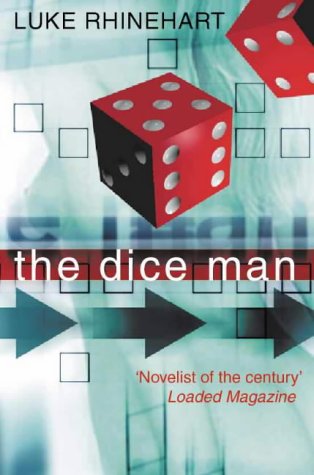
1971: The Dice Man


Book Name: The Dice Man

Author: Luke Rhinehart

Genre: Novel

Year Published: 1971

I actually read the first few chapters of The Dice Man in high school as my friend was reading it & recommended it then. I found it pretty weird and skipped through bits of the book trying to find interesting quotes/sections rather than actually reading the novel. This time around, I read it from start to finish - all 500 odd pages of it! Not quite as long as A Game of Thrones, but still too long when it's not entirely captivating.

The Dice Man is basically about a guy called Luke Rhinehart who is not overly happy with his life and starts to use dice to randomise his activities and personality. (Note: the author's name is listed as Luke Rhinehart, as on the book cover, which is basically to add to the feeling of the book as a kind of diary or memoir. It is in fact a pen name for George Cockcroft.) Whilst some of his dice decisions are quite funny or interesting to read about, such as him changing personalities every 10 minutes at a party, or enabling the "Great Mental Hospital Escape" at times it seems a bit repetitive. As in, oh another scene in which Luke uses the dice as an excuse to seduce a woman.

At times I did think about the book as a sort of giant roleplaying game in which anything goes. I'm used to rolling dice for decision making in character, as well as determining whether my attacks hit someone or whether I'm good enough at diplomacy to persuade someone to let me stay in their inn for free etc. However, The Dice Man takes it to a whole new level where it's about rolling the dice for EVERYTHING from what to wear to whether you are happy or sad or angry to if you're going to rape your neighbour. Yeah, exactly...

Whilst I'm not sure I'd recommend this book to many people as it'd probably upset or annoy them with its content, I can't say it's not good. From time to time it becomes a little boring but then it picks up again and you can't wait to find out what on earth is going to happen to Luke next. I certainly wouldn't recommend trying the dice life full on either as you can imagine how the protagonist's life falls apart pretty quickly. However, occasional dice decisions are pretty common. For example, I'm using a d100 to decide the order I read the books for this blog. People roll dice or flip coins to decide where they will go for dinner/what to watch/who gets that really cool thing they both found at exactly the same time. For little things, it's fun to randomise outcomes. It's just a pretty bad idea when you're doing important things like deciding whether to quit your job.

Other Books I Considered: The Carpet People - Terry Pratchett; Fear & Loathing in Las Vegas - Hunter S. Thompson

Wednesday, 11 September 2013

1913: Pollyanna


Book Name: Pollyanna

Author: E.H. Porter

Genre: Children's

Year Published: 1913

So I actually read Pollyanna back near the end of June, but I kinda forgot to make a post about it til now. I've actually finished another book too since then, so I'll try and post about that one soon as well! Anyway, I really enjoyed reading Pollyanna! It was a lovely, simple book to read and had a happy storyline nearly all the way through, which made a pleasant change from some books I normally read. The story revolves around a little girl called Pollyanna who tries to find something glad in everything that happens, something which resulted in the book and its sequels being referred to as "Glad Books".

During the book, Pollyanna attempts to make other characters join her in playing the "Glad Game" and encourages them to be more optimistic. I found that it did also result in me trying to find more positives in situations that would normally upset or annoy me a bit, which I wasn't expecting. Her character is so sunny and happy about everything I think it's almost impossible for it not to rub off on the reader a little bit! I don't often find characters in books which I particularly relate to or feel the emotions of, and as such I found this book to be very well written and easy to read.

Whilst some of the writing style may be a little too easy for some older readers to enjoy, the overall content of the book is very warm and happy, just perfect for a little pick-me-up or a lighter read between other books. I'd be very surprised if someone else reading it didn't find themselves playing the Glad Game too occasionally, which can't be a bad thing!

Other Books I Considered: Sons and Lovers - D.H. Lawrence; Swann's Way - Marcel Proust

Friday, 21 June 2013

1901: Kim


Book Name: Kim

Author: Rudyard Kipling

Genre: Spy; Picaresque

Year Published: 1901

So despite what I wrote last time, I ended up reading a 1901 novel this time - Kim by Rudyard Kipling. It was indeed difficult to read at times and took me just over a month to read as at times I simply couldn't get into it for more than a few pages (though time constraints didn't help!) Kim started off for me in a very confusing manner as it seems to start of as a kind of religious journey and then suddenly at the end of the first chapter a load of spy language is thrown in and then not mentioned again for a while. However, it was this mishmash of genres that ended up making the book really interesting for me.

The internet tells me that Kim is a spy and picaresque book. The picaresque part is certainly true, but the spy part is more subtle in the book. It is more an underlying theme that you are reminded about from time to time, whilst the main emphasis is on Kim's journey and his growing up. The Indian setting was very interesting to read, but the usage of foreign and archaic words liberally throughout the book made me feel very glad I was using a Kindle with an inbuilt dictionary. However, I don't think the book would have felt quite the same without it as it really adds to his journey due to the way language is used by different characters in the novel.

Overall I only have two complaints about this book. Firstly, the start was very confusing and I didn't really have a clue what was going on in terms of genre and actual storyline till a few chapters in. I am undecided as to whether this a good thing or not. Secondly, it ends quite abruptly. I was fully prepared to keep reading Kim's journey and suddenly the book ended. Certain storylines within the book are left therefore unfinished and you simply have to decide for yourself what might have happened. Interesting for some, maybe, but I found it a bit frustrating. Regardless, I really enjoyed the majority of the story and I would certainly recommend keeping going to anyone else who found it confusing or difficult to read. It is worth the effort!

Books I Read In Between: Monday to Friday Man - Alice Peterson (2011)

Wednesday, 5 June 2013

1900: The Wonderful Wizard of Oz


Book Name: The Wonderful Wizard of Oz

Author: L. Frank Baum

Genre: Fantasy; Children's

Year Published: 1900

For the second book in my challenge I thought I'd go all the way back to the start and the year 1900. Originally I planned to read the full 100 years of books in chronological order, but to be completely honest I thought I would find it a little difficult only reading relatively old books for some time. For example, whilst reading The Wonderful Wizard of Oz, I found that although I could tell it was aimed at children, the language used was of course quite different to what you'd find in a modern children's book, from little things like, "Toto did not like it", as opposed to "Toto didn't like it" to phrases such as "resolved to wait calmly" and "gave a cry of amazement". I read two more recent children's books around the same time as this novel and it's safe to say this kind of phrasing featured in neither of them. Given that this book was aimed at children, I figured that adult novels would be even more difficult to get into reading and so it would perhaps be more fun and refreshing to skip between time periods and genres when choosing which book to read next. I may go for a simple method of rolling a d100 to choose books, but we shall see.

As for the content of the book, I have to say that I did find it fun to read. I watched the film The Wizard of Oz quite a long time ago so I could only remember the basic storyline of Dorothy goes to Oz, meets x, y & z and they all want things so they ask the Wizard for them. Therefore it was quite fun to read the book and rediscover all the events and of course find the ones that didn't even feature in the film, or at least that I don't remember being in the film, such as a land of china people and the field of poppies which makes them fall asleep. Something that struck me in particular was the fact that at times the book was really quite creepy, such as when you think about how exactly is the scarecrow talking when his face is only painted on. But despite a few points like this, where I did question what on earth was going on, and yes, I know it's a children's fantasy novel, it was overall a good and well-written tale and I found it easy to read quickly and often, though maybe I wouldn't recommend it for particularly young children as some of the content is a little weird for nowadays.

Books I Read In Between: Who Could That Be At This Hour? - Lemony Snicket (2012); There's A Boy in the Girls' Bathroom - Louis Sachar (1987)